Thursday, 31 January 2008

¿Tipos o grados de contenido generado por el usuario?

Hace unas semanas tuve un cruce entre dos post. Julen aludía a un artículo del País donde se constataba el escaso porcentaje de los usuarios de páginas Web 2.0 que realmente contribuyen. Es una idea parecida a la ley del 1% de Arthur. Julen constataba como en un espacio de participación masivo, como es Internet, un porcentaje ridículo puede llegar a ser suficiente.

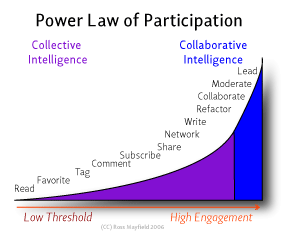
Por otra parte, Riina Vuorikari enlazaba este gráfico de Ross Mayfield.


Las distintas formas de contribución de un usuario forman una curva ascendente que significan que están más implicado. En el update del post hay algunos datos y enlaces más sobre esta idea, aunque nada parecido a un paper. Desde el punto de vista individual, no tiene mucho sentido. Cada usuario estará guiado por sus necesidades y participará de acuerdo a ellas, de modo que los itinerarios de implicación pueden ser muy diversos, pero desde el punto de vista del conjunto de los usuarios de un sitio, es una pregunta que nos podemos plantear: ¿contribuye la frecuencia de contribuciones de menor grado a aumentar la frecuencia de las contribuciones de mayor grado?

Tuesday, 8 January 2008

Beyond OER

John Seely Brown was at the UOC and Ismael Peña give us a good and concise report of his speaking. The subject was OER and the speaker comes with the question on how to go further in openness for learning after the free provision of materials. And says:

Understanding is socially constructed.

This is not new from the pedagogic perspective, but it is interesting to think that it's not enough to give free materials, there is a lot to do in the field of open discussion, social information retrieval... Well, I'm not catching all the interesting clues of this idea, this is just a quick post to remember to read it again, and to go further with three other links at the bottom of the post.

A definition of social information retrieval?

It's pretty evident that information retrieval in the web rely, among other things, in mechanism based in a bottom-top logic. Pagerank harness individual decisions to give relevant results in the queries, and this has a social and "democratic" logic and, up to now, it's the best way to retrieve information from the never-ending WWW.
We can think of this outside the bounds of the Internet. We do search for information in brick and mortar life looking at what other people do or tell us they do (word of mouth). We can do a lot of this in the Internet, a perfect place to nose around, and even better since we have applications like del.icio.us or myspace that invite to do social navigation. Furthermore, other applications have mechanism to retrieve our opinions (digg, or any other place where we are asked to rate) o simply do the job for us, as Amazon or Pandora collaboratively filtering.
Retrieving (selected) information is very related to what a users want to do in a thematic portal, so, as this is the context of my phD, I bookmarked on the spot the SIRTEL07 workshop when I first saw it. Despite the interest of the papers I found there, no one of them gave me a clear definition. So I googled around and got this:
Social information retrieval systems are distinguished from other types of ir (Information retrieval) systems by the incorporation of information about social networks and relationships into the information retrieval process.

The paper in interesting but still is too much centered on searchers and not on social navigation and all the other stuff I mentioned before. Eventually I found better, but still in press: a book on social information retrieval that is considering it very widely, from algorithms to social bookmaking and even design.
Thursday, 3 January 2008

I want my data back

Downes tell us about a guy who has been fired from Facebook: "I am working with a company to move my social graph to other places and that isn't allowable under Facebook's terms of service." Maybe what this guy was doing was forbidden, but what Facebook did, deleting his account, is also forbidden. Anyway, nor Google neither anyone in the web 2.0 arena allow you to make a back up of your data, even if Open Social business model, data can go beyond the bounds of the silo where the user out them.

Interesting link about open networks http://www.dataportability.org/

Wednesday, 2 January 2008

A matter of collaboration

Can we really speak of a collective intelligence merging from the action of scattered users? Can we speak about a will of collaboration or, maybe, it's just that particular and collective interests are matching together? Do we contribute because social tools are useful for us, because we love the idea of open content or because we are trying to achieve a digital reputation? To which extent one or the other motivations are working?
I hear quite often that users begin to use social software because of a personal interest, like the advantage of ubiquity when bookmarking at del.icio.us, and the sum of all these interest is what make new value for the community. Right, but these instrumental goals come together with other social goals, because users are aware that there are not taking notes in their personal notebook and also aware that one tag or another can make more people find these personal bookmarks.
So instrumental and social goals meet together when a user is deciding whether to collaborate and make open its content, links... or keep it in his own folders. Peter Kollock Social dilemmas, anatomy of cooperation is maybe a good perspective to study what's happening between the individual and the collective, even more when we see that this author has also edited a book where the nature of virtual communities is also explored: Communities in cyberspace
And on top of this we have the digital divide matter: a few days ago, danah boyd talked about a first PEW report about adults footprints. Digital footprints is more about privacy than contributing and adding value, but the idea is that adults are very likely to leave information about themselves but they are saying just the opposite, specially to their children. A few days later another report is commented in the same blog. This one is about young people, "teens are much more protective of the content they post online than adults are".

Tuesday, 1 January 2008

Personal mediated communication and the concept of community

(pre- reading notes) This chapter explores the relationship between the mediated communication and the creation and evolution of communities. After making a revision of the definitions of community that can be relevant, the chapter explores "examines mediated communications, especially the Internet and mobile phone technology, and their potential impact on social relationships within communities"
This link was found in an open Syllabus of a course og H. Reinghold.